


 English
 Español
 عربى
عربى
Is Dyneema Good for Mooring Lines? Performance Explained
محتوى
- 1 The Short Answer: Yes, But With Important Caveats
- 2 What Dyneema Actually Is and Why It Performs Differently
- 3 Strength-to-Weight Ratio: Where Dyneema Has No Equal
- 4 The Stretch Problem: Why Low Elongation Is a Double-Edged Sword
- 5 UV Resistance and Long-Term Durability in Marine Environments
- 6 Creep: The Slow Stretch That Changes Tension Over Time
- 7 Where Dyneema Mooring Lines Genuinely Outperform the Alternatives
- 8 Where Dyneema Is a Poor Choice for Mooring
- 9 Dyneema vs. Nylon vs. Polyester: A Direct Comparison for Mooring
- 10 Snap-Back Risk: Safety Implications of Using Dyneema for Mooring
- 11 Knots, Splices, and Hardware Compatibility
- 12 Cost Analysis: Is the Price Premium Justified?
- 13 Inspection and Maintenance of Dyneema Mooring Lines
- 14 Practical Recommendations by Vessel Type and Mooring Situation
The Short Answer: Yes, But With Important Caveats
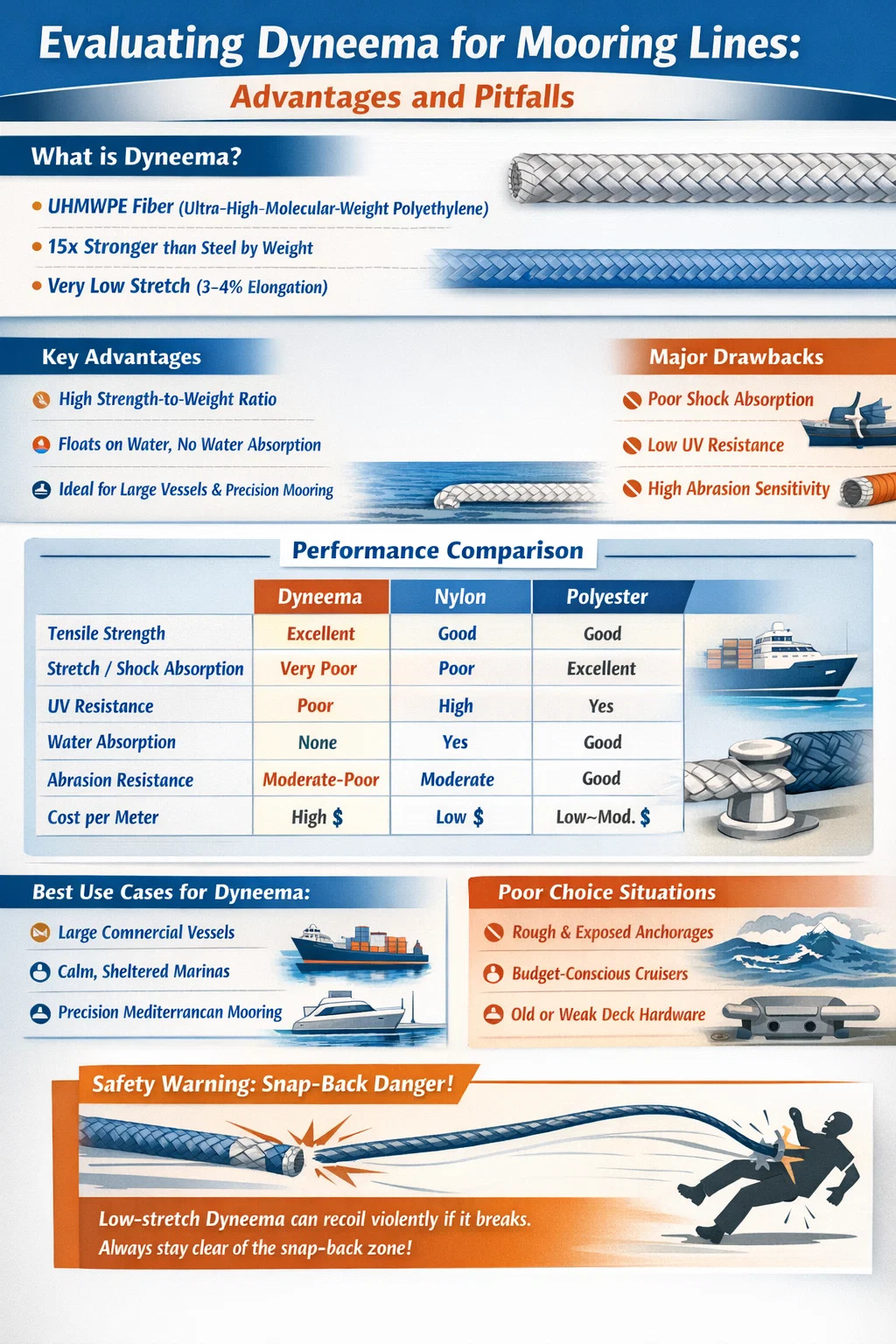
Dyneema is an outstanding mooring line material in several specific conditions — but it is not universally the best choice for every boat or every mooring situation. For vessels where weight savings, high load capacity, and minimal creep matter most, Dyneema delivers performance that nylon and polyester simply cannot match. However, its near-zero stretch is both its greatest strength and its most significant liability in dynamic mooring environments where shock absorption is critical.
Understanding where Dyneema excels and where it falls short requires looking at the physics of mooring loads, the chemistry of UHMWPE fibers, and how real-world conditions interact with rope behavior. This article covers all of that in practical detail.
What Dyneema Actually Is and Why It Performs Differently
Dyneema is a brand name for Ultra-High-Molecular-Weight Polyethylene (UHMWPE) fiber, manufactured by DSM (now part of Avient Protective Materials). The fiber is produced through a gel-spinning process that aligns the polymer chains almost perfectly along the fiber axis, creating extraordinary tensile strength relative to weight. Dyneema SK75, a commonly used grade in marine applications, has a tenacity of approximately 34 cN/dtex, making it roughly 15 times stronger than steel by weight.
This molecular alignment also explains one of Dyneema's defining characteristics as a mooring line: extremely low elongation at break, typically in the range of 3–4% depending on construction, compared to 20–30% for nylon and 8–15% for polyester. That difference fundamentally changes how a mooring system behaves under load.
The material's density is also notable — UHMWPE floats on water (density approximately 0.97 g/cm³), which has practical implications for line handling and for preventing fouling around propellers.
Strength-to-Weight Ratio: Where Dyneema Has No Equal
For a given diameter, Dyneema mooring lines are dramatically stronger than any conventional fiber alternative. This has real consequences for line selection and system design.
| Rope Material | Typical MBL at 16mm (kN) | Elongation at Break (%) | Weight per Meter (g/m) |
|---|---|---|---|
| Dyneema (UHMWPE) | ~190–220 | 3–4% | ~100–115 |
| Nylon (Polyamide) | ~55–75 | 20–30% | ~160–185 |
| Polyester (Dacron) | ~65–85 | 8–15% | ~155–175 |
| Polypropylene | ~40–55 | 15–25% | ~110–130 |
A 12mm Dyneema line can often exceed the breaking load of a 20mm nylon line, which matters in tight fairleads, crowded cleats, and weight-sensitive applications. On racing yachts, offshore vessels, and large superyachts, this allows system designers to reduce line diameter, save weight aloft and on deck, and still maintain or improve safety margins.
On commercial vessels and larger workboats, the weight savings become even more significant. A 200-meter drum of 28mm nylon can weigh over 400 kg, while an equivalent Dyneema line of comparable breaking load might weigh under 160 kg — reducing handling fatigue and improving deployment speed.
The Stretch Problem: Why Low Elongation Is a Double-Edged Sword
This is the most important consideration when evaluating Dyneema for mooring lines, and it is frequently misunderstood. The near-zero stretch of UHMWPE is excellent in towing, lifting, and racing applications where load control and minimal movement are desirable. In mooring, the picture is more complicated.
When a vessel moored with Dyneema lines experiences a sudden surge — from a passing vessel's wake, a wind gust, or tide-induced movement — the kinetic energy of that movement has nowhere to go. A stretchy nylon line absorbs that energy by elongating, then returns the energy gradually as it contracts. A Dyneema line transmits that load spike almost instantaneously to the cleat, the fitting, the vessel structure, and the dock hardware. The result can be broken cleats, cracked stanchions, failed mooring points, or snapped lines — despite the line itself being technically rated for the load.
This is not theoretical. In commercial harbor operations, there are documented cases of Dyneema mooring lines parting violently on vessels where nylon lines would have held, specifically because the snap-back energy at failure with a low-elongation rope is far more dangerous than with nylon. The energy stored in a stretched nylon line is released progressively; the energy in a taut Dyneema line under dynamic loading is released almost like a projectile when it fails.
When Stretch Actually Protects Your Vessel
Consider a 15-meter sailing yacht moored bow-to at a Mediterranean pontoon in a summer storm. Wind gusts to 35 knots push the boat repeatedly against its lines. With nylon spring lines, the elasticity acts as a shock absorber — the boat surges forward, the lines stretch and pull it back gently. With Dyneema spring lines rigged at the same tension, each surge produces a hard jerk on the fittings. Over a 12-hour storm, this cyclic shock loading can fatigue cleats that would otherwise handle the peak load easily under static conditions.
In tidal waters with significant range — think Bristol Channel with its 12-meter tides, or parts of the Brittany coast — mooring lines must also accommodate large changes in the vessel's vertical position. Nylon handles this through compliance. A Dyneema line in the same situation requires more careful slack management, because even small variations in tension become more abrupt without the buffer of elongation.
UV Resistance and Long-Term Durability in Marine Environments
Dyneema has excellent chemical resistance and does not absorb water, which prevents the hydrolysis degradation that gradually weakens nylon when it cycles between wet and dry states. However, UHMWPE has significantly lower UV resistance than polyester, and unprotected Dyneema left in continuous Mediterranean or tropical sunlight will suffer meaningful strength loss over 12–24 months.
Most quality Dyneema mooring lines address this through a protective outer jacket — typically polyester braided over the UHMWPE core. This construction is often called a "double braid" or "coated Dyneema" and it substantially extends working life. The polyester cover handles abrasion and UV exposure, while the Dyneema core carries the structural load. Without that cover, or once the cover is severely worn, the core's lifespan under UV exposure is limited.
For comparison, a well-maintained polyester double-braid mooring line used in a typical marina might have a practical service life of 8–12 years with annual inspection. A covered Dyneema line used as a permanent mooring warp, with regular inspection, can also reach that range — but an uncovered 12-strand Dyneema used in direct sunlight might show significant degradation within 3–5 years depending on latitude.
Abrasion: A Real Concern at Chafe Points
Despite its extraordinary tensile strength, Dyneema has relatively poor resistance to abrasion compared to polyester or nylon. The same molecular alignment that creates its tensile performance makes the fiber sensitive to cross-directional cutting and grinding forces. Where a mooring line runs over a rough fairlead, across a dock edge, or through a cleat with sharp internal radii, Dyneema can sustain surface damage at contact points that quietly reduces its effective breaking load without being obvious to visual inspection.
This is a practical management issue, not a reason to avoid Dyneema, but it requires attention. Chafe guards should be used aggressively at all contact points. Fairleads and cleats with smooth, generous radius profiles protect the line significantly better than older hardware with sharp edges.
Creep: The Slow Stretch That Changes Tension Over Time
Dyneema undergoes creep — very slow, continuous elongation under sustained load — at a rate that depends on load level and temperature. At loads below 20% of minimum breaking load (MBL) and at ambient marine temperatures, creep in Dyneema SK75 is very low, typically less than 0.5% over extended periods. At higher sustained loads or elevated temperatures, creep becomes more significant.
For mooring applications, this means a Dyneema line left on a mooring for months at moderate tension will very slowly elongate, which can cause the line to become slightly slack over time. In practice, this is a manageable issue — far less significant than the creep behavior of polypropylene, for instance — but it is worth monitoring on long-term permanent moorings.
DSM's own technical documentation distinguishes between SK75 and SK90, with SK90 offering lower creep rates at the cost of slightly reduced flexibility. For permanent mooring applications where a long-term consistent tension is important, SK90 or Dyneema DM20 (a more creep-resistant variant) may be preferable to standard SK75.
Where Dyneema Mooring Lines Genuinely Outperform the Alternatives
With a balanced understanding of both its strengths and limitations, here are the specific mooring applications where Dyneema provides clear advantages:
- Large commercial vessels and superyachts where bollard pull and line weight on long runs create fatigue and handling challenges — Dyneema's weight advantage reduces crew workload significantly.
- Calm or sheltered anchorages and marinas with minimal surge and wave action, where dynamic shock loading is not a primary concern.
- Stern-to or bow-to Mediterranean mooring where precision positioning is critical and excessive stretch would cause the vessel to swing unpredictably.
- Mooring in areas with fouling risk, since Dyneema does not absorb water, resists growth better than natural fibers, and floats — reducing the chance of lines wrapping around propellers during maneuvering.
- Situations requiring high safety factors at reduced diameter — Dyneema allows a thinner line that is easier to handle, coil, and store while still providing substantial reserve capacity above working loads.
- Hybrid mooring systems where Dyneema is used for the primary structural elements (bow lines, stern lines) and nylon is retained for springs and breast lines where shock absorption is needed.
That last point — the hybrid approach — is how many experienced offshore sailors and professional yacht captains actually deploy Dyneema. Rather than replacing all lines with Dyneema, they use it selectively where its properties provide the greatest benefit.
Where Dyneema Is a Poor Choice for Mooring
Being clear about these situations is just as important as recognizing where Dyneema excels:
- Exposed anchorages and marinas with significant surge — places regularly affected by swell, ferry wash, or strong tidal currents. The absence of stretch turns every surge event into a hard shock load.
- Budget-conscious cruising sailors — quality covered Dyneema mooring lines cost 3–5 times more per meter than equivalent nylon, and the performance advantage does not justify that premium for typical leisure mooring on a 35-foot yacht.
- Vessels with marginal or aging deck hardware — Dyneema's lack of stretch means your cleats and fitting bases receive higher peak loads than they would with nylon. If hardware is already borderline, switching to Dyneema can move a marginal fitting into failure territory.
- Mooring in high UV environments without a protective cover — bare Dyneema 12-strand left in tropical sun will need more frequent replacement than polyester in the same conditions.
- Situations where lines run over sharp or rough surfaces without proper chafe protection — Dyneema's abrasion sensitivity requires higher maintenance attention at contact points than polyester.
Dyneema vs. Nylon vs. Polyester: A Direct Comparison for Mooring
| Property | Dyneema (UHMWPE) | Nylon | Polyester |
|---|---|---|---|
| Tensile strength (by diameter) | Excellent | Good | Good |
| Shock absorption / stretch | Very Poor (3–4%) | Excellent (20–30%) | Moderate (8–15%) |
| UV resistance (bare fiber) | Poor | Moderate | Good |
| Water absorption | None | High (up to 8%) | Low (<1%) |
| Floats in water | Yes | No | No |
| Abrasion resistance | Moderate–Poor | Good | Excellent |
| Weight (same breaking load) | Lightest | Heaviest | Heavy |
| Cost per meter (relative) | High (3–5×) | Low | Low–Moderate |
| Snap-back danger at failure | Very High | Moderate | Moderate |
Snap-Back Risk: Safety Implications of Using Dyneema for Mooring
This deserves its own section because it is genuinely a safety issue, not a minor technical footnote. When a loaded rope under tension fails, it releases stored elastic energy. The lower the elongation, the faster and more violently that energy is released.
In commercial shipping, OCIMF (the Oil Companies International Marine Forum) and MCA guidance both address the dangers of high-strength, low-elongation mooring lines extensively. Major incidents — some fatal — have occurred on tankers and bulk carriers where HMPE (high-modulus polyethylene, the category Dyneema belongs to) mooring lines failed under dynamic loading and the snap-back struck and killed or seriously injured personnel on deck.
For the leisure sailor, the risk scale is smaller, but the physics are identical. A taut Dyneema mooring line that fails under a surge event can recoil at very high speed. Anyone standing in the line's potential snap-back zone is at serious risk. On commercial vessels, mandatory exclusion zones are marked around HMPE mooring lines during operations. Leisure sailors typically do not follow such protocols, which makes this risk more, not less, significant.
Practical mitigation: use "snap-back reducers" — purpose-made weighted bags or sleeves that absorb some recoil energy if the line parts. Also, never stand in the direct line of tension on a loaded Dyneema mooring line, and ensure guests and crew are aware of this risk.
Knots, Splices, and Hardware Compatibility
Dyneema's slippery surface creates significant knot security issues. Conventional knots that hold reliably in nylon or polyester — the bowline, cleat hitch, clove hitch — can slip or progressively capsize in pure Dyneema, especially 12-strand constructions without an outer jacket.
A properly eye-spliced Dyneema line retains approximately 95% of its MBL, whereas a bowline in bare Dyneema may retain only 50–65% of MBL due to the tight bend radius and slippage under load. This means that splicing is strongly preferred over knotting for permanent or semi-permanent Dyneema mooring lines.
If you use covered Dyneema (polyester jacket over UHMWPE core), conventional knots are more reliable on the outer jacket, but you still lose a significant fraction of the core's capacity at the knot. A buried splice through the cover and core is the correct technique for high-performance use.
Cleat and Fairlead Compatibility
Because Dyneema lines are typically smaller in diameter for a given breaking load, they can behave differently on standard marina cleats designed around conventional rope diameters. A 10mm Dyneema line rated to replace a 20mm nylon line may not wrap a standard cleat as securely simply due to contact area geometry. This is particularly relevant for quick-release applications and for boats using standard cam cleats or jammer systems.
Additionally, Dyneema's low coefficient of friction can cause line to slide through clutches and jammers that are calibrated for grippier fiber types. Always verify cleat and hardware compatibility before switching to significantly thinner Dyneema on a system originally sized for nylon.
Cost Analysis: Is the Price Premium Justified?
As of current market pricing, a quality 16mm covered Dyneema mooring line (e.g., Marlow D2 Racing or Samson AmSteel-Blue equivalent) runs approximately €25–40 per meter from European marine chandlers. Comparable 16mm nylon double-braid costs €4–9 per meter. The material cost for outfitting a 45-foot yacht with Dyneema mooring lines could easily reach €2,000–3,500, compared to €400–700 for nylon.
Whether that premium is justified depends on the use case:
- For a racing or performance yacht where every kilogram matters and lines are frequently handled, the weight and handling advantage is likely worth the cost.
- For a commercial vessel where crew handling time and the logistics of carrying heavy line drums have a real monetary cost, the economics can favor Dyneema on a total cost of ownership basis.
- For a cruising family that moors in mixed conditions and uses their lines primarily to hold position overnight, the performance advantage does not meaningfully translate into better real-world outcomes — and the money is better spent elsewhere.
A reasonable middle-ground approach for cost-conscious sailors is to use Dyneema for one or two primary lines — perhaps the bow line and a long stern spring — where its strength-to-weight benefit is most apparent, and to retain quality nylon for the remaining lines where stretch and shock absorption are more valuable.
Inspection and Maintenance of Dyneema Mooring Lines
One of the practical challenges with Dyneema — particularly core-dominant constructions — is that damage is harder to detect visually than in nylon or polyester. Nylon shows degradation through discoloration, stiffness, and obvious surface fraying. A Dyneema line can lose significant strength through internal fiber damage, UV degradation of unprotected core fibers, or localized abrasion that does not manifest as obvious external damage.
Inspection recommendations for Dyneema mooring lines:
- Check the outer jacket at all chafe points before and after every significant mooring period. Worn areas on the jacket indicate the core may be compromised.
- Look for "glazing" — a shiny, hardened surface on the outer jacket or bare Dyneema. This can indicate heat damage from friction, which significantly reduces strength.
- Check splices annually. A buried splice in Dyneema that begins to pull can show subtle signs of distortion before it fails — frequent inspection catches these early.
- Retire Dyneema mooring lines that have been subjected to shock loads near MBL — even if they appear intact. Internal fiber damage from overloading is not always visible externally.
- For covered lines, periodically inspect a short section of the core if possible by gently opening the jacket weave at a non-critical section. Core discoloration or brittleness indicates UV penetration.
Practical Recommendations by Vessel Type and Mooring Situation
Leisure Sailing Yachts (10–15 Meters) in Marina Berths
Use quality nylon double-braid as the default. It provides the shock absorption that marina mooring demands, costs a fraction of Dyneema, is easy to splice or knot, and degrades gracefully in a way that is straightforward to monitor. If weight is a concern, consider covered Dyneema for just the bow lines on a stern-to berth.
Performance and Racing Yachts
Dyneema is the natural choice where it can be properly integrated. Use covered Dyneema for dock lines, ensure all terminations are spliced (not knotted), install proper chafe protection at every contact point, and retain nylon shock-absorbing pendants at the dock connection points to address the stretch deficit.
Motorboats and Superyachts Over 20 Meters
Dyneema offers meaningful benefits at this scale — weight, storage volume, and handling effort are significant. Consider a hybrid system: Dyneema headline and stern lines with nylon spring lines, or use Dyneema lines with integrated nylon stretch sections (available from several specialist manufacturers) that add compliance to the system.
Offshore Cruising Vessels
Offshore cruisers encounter the widest variety of mooring conditions — everything from sheltered lagoon moorings in the Pacific to rolly anchorages in the Atlantic. Carrying a mix of line types makes sense. Nylon as the primary mooring material, with a set of lighter Dyneema lines for situations where raw strength at low weight is needed (kedging, towing, emergency anchoring).
Commercial Vessels and Ferries
Follow OCIMF guidelines and vessel-specific mooring analysis. HMPE lines (including Dyneema) are standard on many larger commercial vessels but require specific crew training, snap-back zone awareness, and hardware compatibility checks. Do not assume leisure-market Dyneema products meet commercial certification requirements — verify against applicable standards such as EN ISO 9554 or equivalent.
المنتجات ذات الصلة
-
 عرض المزيد
حبل أحادي الخيط البولي بروبيلين من 3 خيوط
-
 عرض المزيد
حبل هوسر متعدد الخيوط البولي بروبيلين من 3 خيوط
-
 عرض المزيد
حبل هوسر أحادي الخيط البولي بروبيلين من 8 خيوط
-
 عرض المزيد
حبل متعدد الخيوط البولي بروبيلين من 8 خيوط
-
 عرض المزيد
حبل هوسر متعدد الخيوط البولي بروبيلين من 12 خيطًا
-
 عرض المزيد
حبل هوسر مضفر مزدوج متعدد الشعيرات البولي بروبيلين
-
 عرض المزيد
حبل بولي بروبيلين متعدد الشعيرات منخفض الارتداد
-
 عرض المزيد
ذيل ربط متعدد الشعيرات البولي بروبيلين
-
 عرض المزيد
حبل بوليستر 3 خيوط
-
 عرض المزيد
حبل هوسر البوليستر من 8 خيوط
-
 عرض المزيد
حبل هوسر البوليستر من 12 خيطًا
-
 عرض المزيد
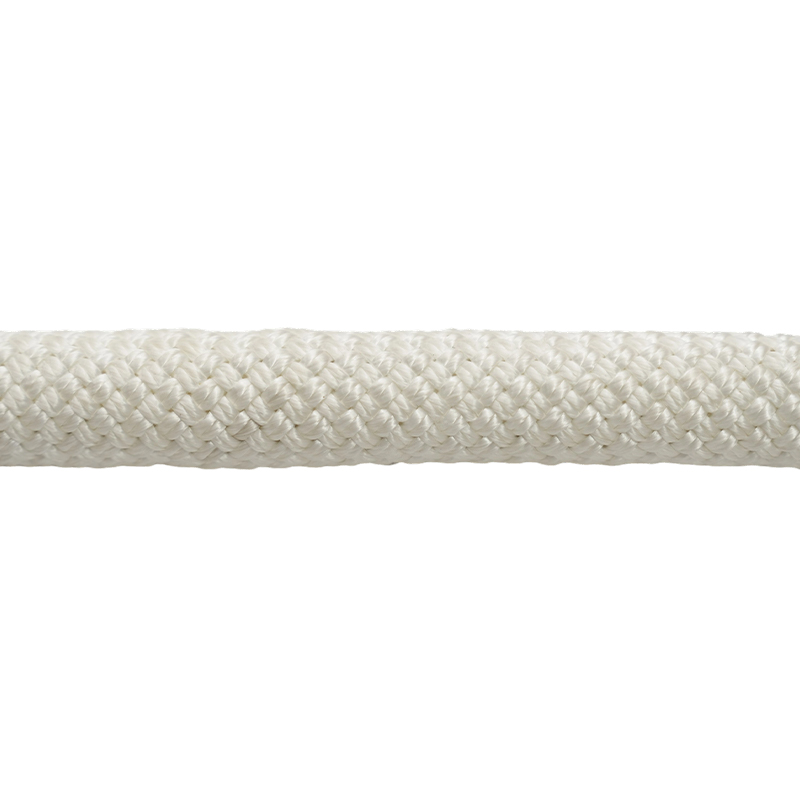
حبل هوسر البوليستر مضفر مزدوج